“Okay. So, we've got freezing rain coming. Snow too. We'll be in IFR conditions with a low ceiling tonight, until early tomorrow morning.”
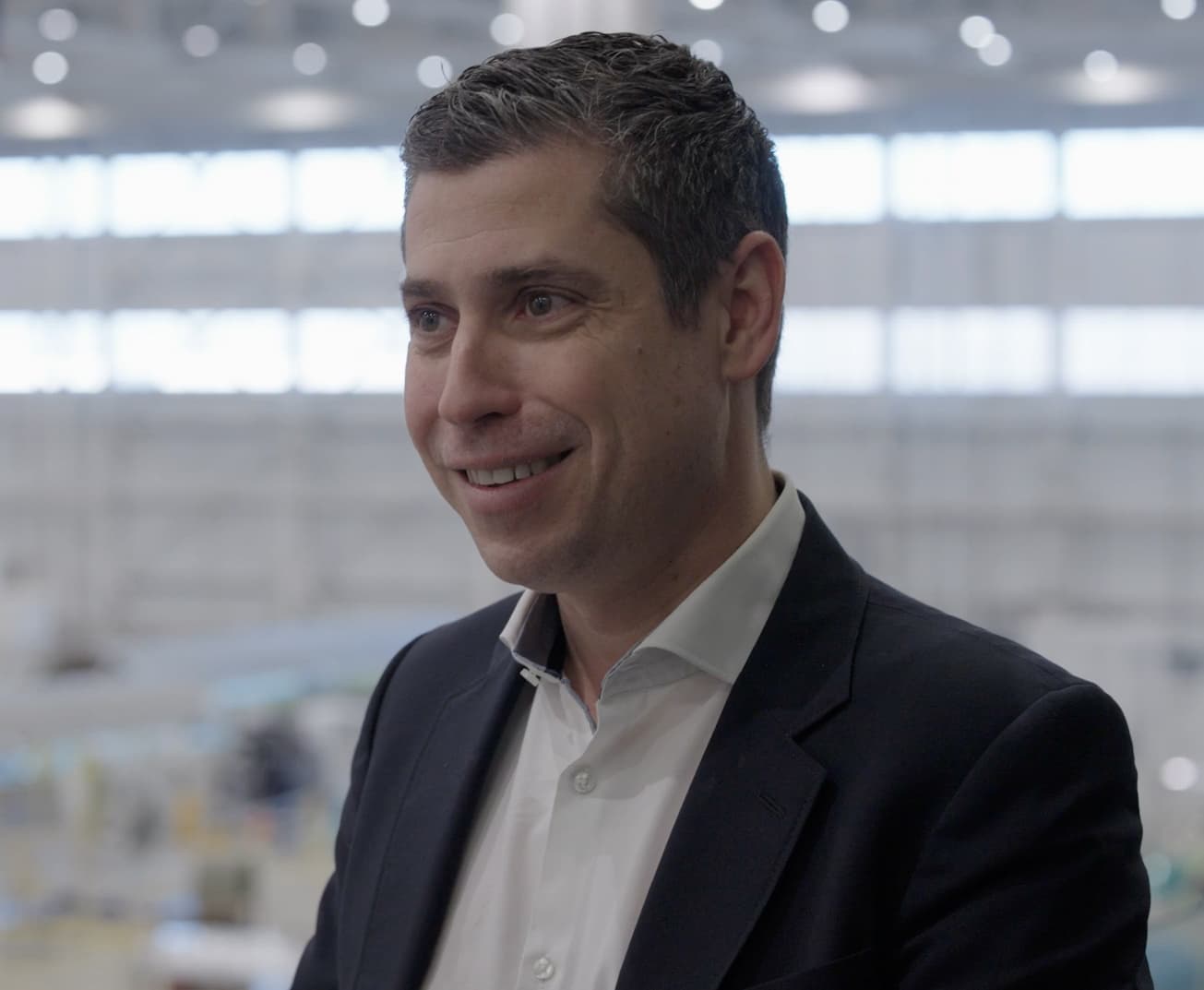
In the briefing room of the Wildcats hangar in St-Hubert, Lieutenant-Colonel Guillaume Mallet listens carefully to the latest weather reports from his officers. On this cold Saturday of November, even though the forecast is looking bad later in the day, the Commander of the 438th Squadron remains confident: the BTAC exercise will go ahead this morning.
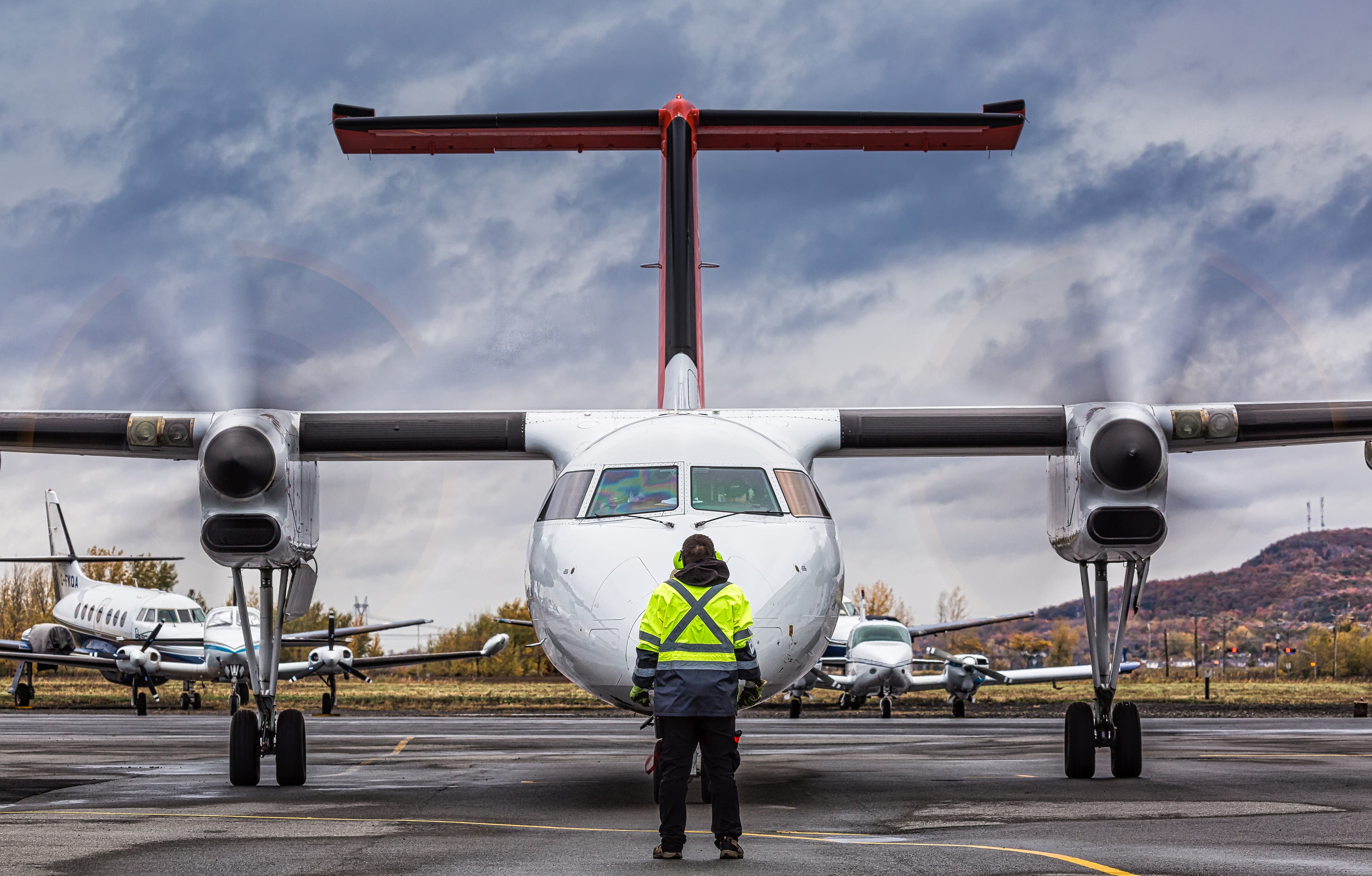
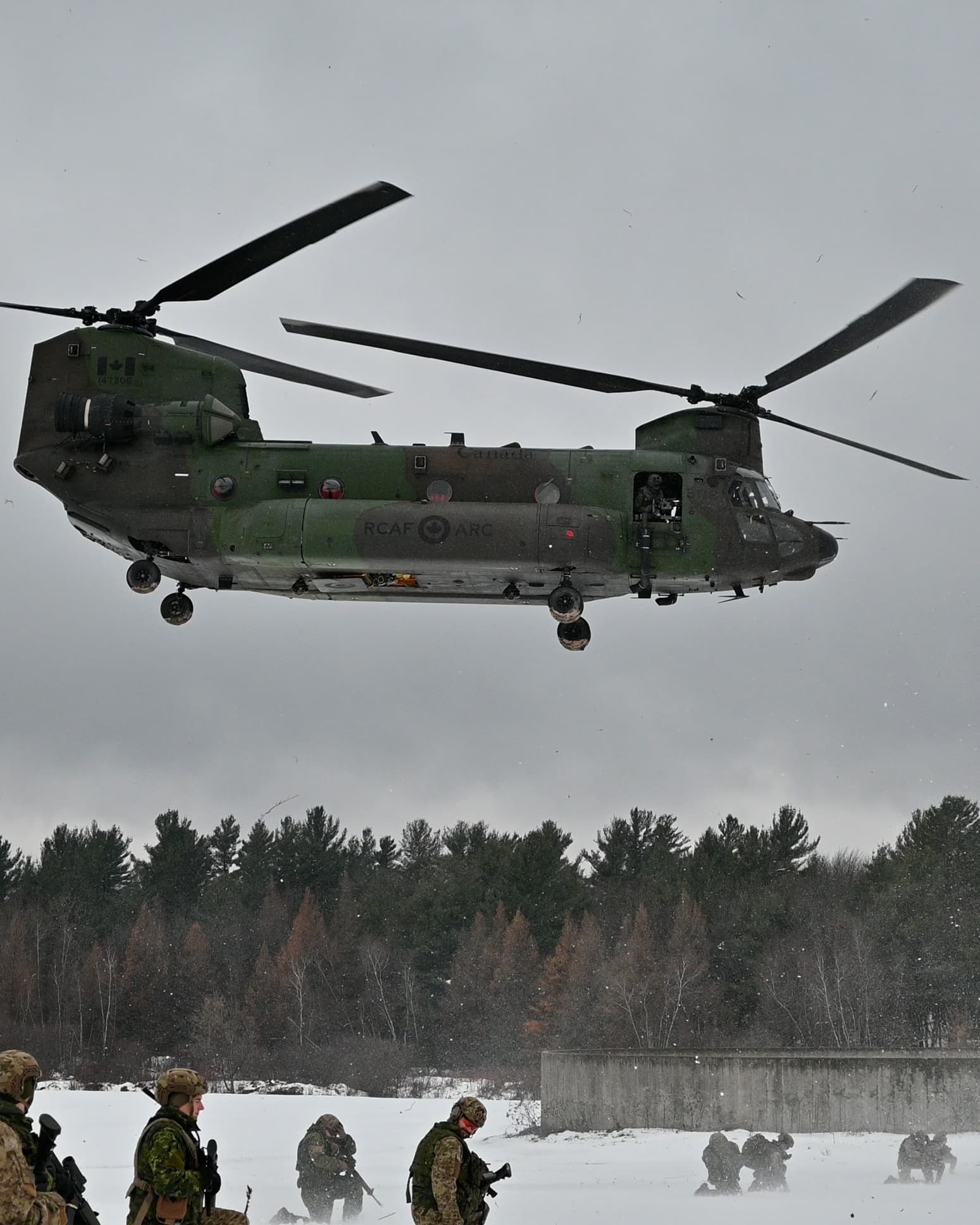
Outside, the rotors are already spinning at full speed. Three huge Chinook helicopters, flown in specially from Petawawa base, catch everyone’s eye. A little further along the apron, three CH-146 Griffon helicopters are ready for takeoff.
But one detail stands out: imposing C6 machine guns are mounted on each of the aircraft.
Proof that the training that is about to begin is unlike any other.
The BTAC (basic tactical aviation course) is an intense and extremely realistic exercise. This is the first time it’s being held in St-Hubert. And for the occasion, Propelia had privileged access.
That morning, the Eastern Townships became Lithuania. From Farnham to Magog, from Valcourt to Sutton: the entire region served as training ground for Canadian soldiers. That day, the scenario goes as follows: the Griffons will escort a convoy on the road. But things will not go as planned. Obviously...
BTAC officials have added ambushes: enemies who open fire on the helicopters. “Our pilots have to learn how not to become targets. This forces them to fly tactically, and to fly very fast and very, very low,” explains Major Yvon Voyer.
Lower? How much lower? “Well... let's say, 15 feet above the ground. As long as they don't touch the ground, it's fine.” It's just one way of highlighting the unique training and abilities of these pilots.
Machine guns are being used—with blank ammunition, of course. One of the Chinook helicopters even lands in the middle of a field to pick up a fake wounded soldier. All this is made possible thanks to the cooperation of citizens who have agreed to lend their land for the purposes of the exercise.
“We are monitoring social media. So far, there have been no concerning comments from the public. But we are continuing to monitor the situation and will provide you with a more detailed report this afternoon,” says Officer Meagan Pye, head of public affairs, with the aim of informing Commander Mallet of any signs of concern among the population of the Eastern Townships and Montérégie.
“The first comments from our pilots when they return to the hangar are that it's very realistic. It's not just a military training area—we have a playground and a good relationship with the civilians. It's a good representation of what we're currently seeing in Latvia”
explains Commander Mallet
Over 200 people... and 4 pilots
The BTAC exercise is a large-scale operation, lasting a full month, and clearly requiring significant resources, both material and human. “Certainly over 200 people,” adds Commander Mallet.
But in the end, it will only train four pilots.
“We have one pilot from 408 Squadron in Edmonton. Another from 430 Squadron (Valcartier). And two Chinook pilots from Petawawa,” explains Lieutenant-Colonel Mallet. “These pilots have reached a certain level of maturity as tactical commanders in their squadrons. And by coming here for BTAC training, they will become tactical formation leaders. This gives them additional certification and responsibilities.”
“They are being taught how to coordinate missions between the Chinook and the Griffon. If they succeed, they will be able to move on to an even more advanced course, where they will learn how to coordinate operations between helicopters and fighter jets,” explains Commander Mallet.
However, the risk of failure is very real. “Sometimes pilots don't pass the course. It happens.”
A drawing by Walt Disney in St-Hubert
On the second floor of the hangar, the Lieutenant-Colonel shows us around his office, where a precious frame takes pride of place. Underneath the windowpane is a small hand-drawn picture of a big cat winking, wearing aviator sunglasses pushed up on its nose.
The drawing is only a few square centimeters in size. The surprise lies elsewhere: in the signature at the bottom right. “Yes, Walt Disney himself drew our emblem!” confirms Guillaume Mallet.
Legend has it that in 1944, a pilot from Squadron 438 named Ross Reid took a chance and wrote a letter to Walt Disney. He asked him to design a drawing to represent his squadron. A few weeks later, an envelope was returned to him. Inside was a small drawing of a very special Wildcat, created by the great Walt Disney himself.
To this day, the precious design represents the St-Hubert Squadron and is clearly visible on the right sleeve of each uniform.
St-Hubert: a unique model in Canada
No fewer than 265 people currently work in the 438th Squadron in St-Hubert. “Our squadron is truly unique: we have a 50/50 split between reservists and regular members. Even our chain of command has had trouble replicating this structure. Several general officers have come to see us to try and understand it. It's unique in Canada.”
However, Commander Mallet points out that most reservists work almost full-time for the squadron. “Pratt & Whitney, Bombardier, Rolls Royce: many of our technicians have two jobs. They bring civilian expertise to our operations.”
The CH-147F Chinook: Inside the Beast
“It is rare that we manage to get these big beasts into our hangar,” says Commander Mallet with a laugh. In front of us, the rear ramp of one of the three Chinooks is lowered, revealing the interior of the huge aircraft.
Nothing luxurious. Nothing comfortable. Thirty-two canvas seats, nothing more.
“This summer, we crammed nearly 65 people in there. Women. Children. Even animals! We had to get those people out of the forest fires in the west of the country at all costs,” one of the maintenance technicians explains proudly.
The Chinook, easily recognizable with its twin synchronized rotors, is primarily designed for combat missions. With machine guns on the sides, ballistic protection plates on the floor, a laser missile detection system, and infrared countermeasure flare launchers installed at the rear, it is more than well equipped.
“But it can also be turned into a flying hospital,” explains Lieutenant-Colonel Mallet. “In 2019, in Mali, we had surgeons on board who began treating the wounded during the flight. It's hard to say how many people we saved that way—but we gained critical minutes.”
A historic propeller
The Commander walks ahead and opens the door to La Tanière, the squadron's small cafeteria.
“Do you know what’s that, on the wall?”
The piece is imposing. A propeller, obviously. But certainly not from a helicopter. The solid wood and gilded edges evoke a piece of handcrafted equipment from another era.
“It's a propeller from the R-100!” explains Guillaume Mallet. He is referring to the famous airship that docked at the St-Hubert airport in 1930 after flying 5,400 kilometers across the Atlantic.
The Commander explains that this propeller was intended as a spare part, in case of damage to the famous aircraft. It had been shipped by boat to St-Hubert—but in the end, it was never used.
“The propeller was sent here. And over the years, it was protected—perhaps even forgotten!—by the staff. But someone remembered it was there. And we decided to put it on the wall,” explains the Lieutenant-Colonel with a laugh.