Freezing rain, heavy, waterlogged snow, freeze-thaw cycles: in the context of climate change, these phenomena are increasingly frequent and intense. Above all, they are causing icing conditions that are more severe, persistent, and difficult to anticipate.
Despite technological advances, icing remains a recurring cause of serious incidents and accidents in aviation.
For example, in August 2024, the crew of an ATR-72 lost control of the aircraft near Campinas, in Brazil. The cause: rapid ice accumulation during flight, which led to a stall and then a ground impact. All of the occupants perished.
In 2020, a Dash-8 aircraft preparing to land at Bergen Airport in Norway suffered a total loss of power. Ice had broken off the aircraft and entered the engines, an event that highlights the continuing vulnerability of propulsion systems in severe icing conditions.
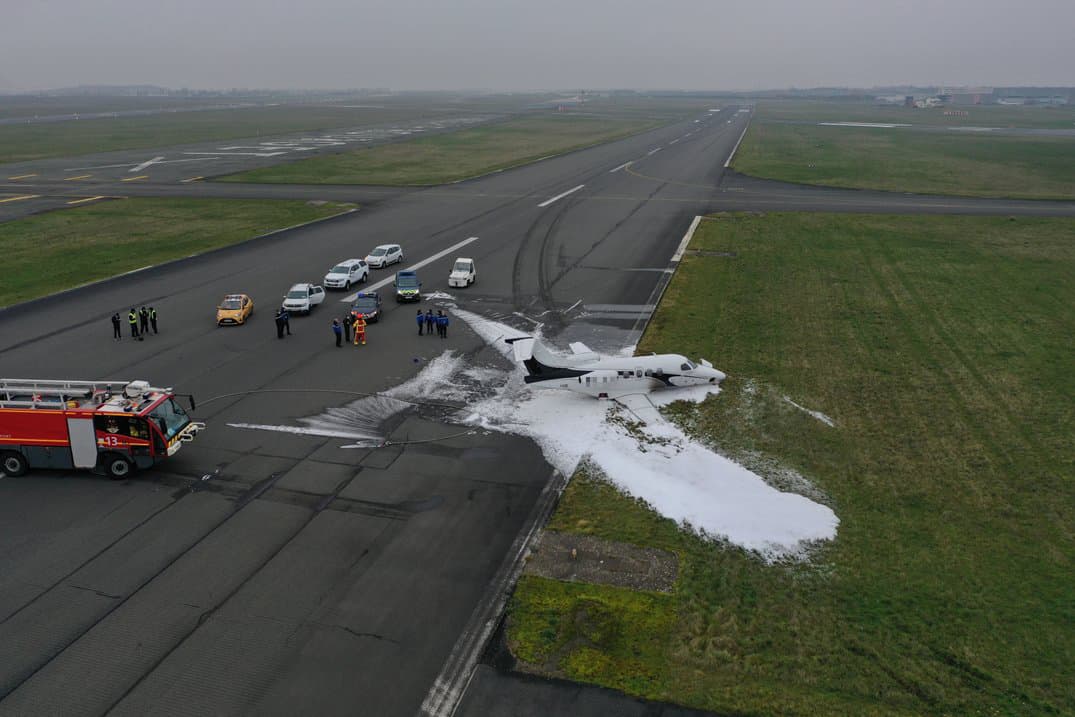
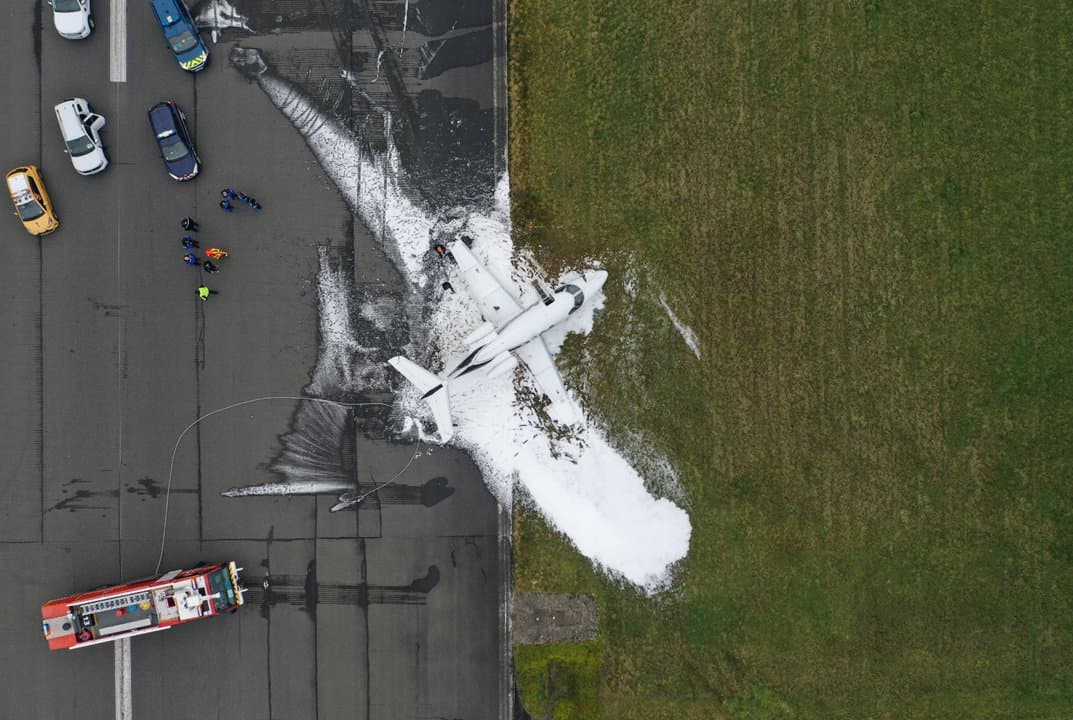
More recently, in 2021, an Embraer Phenom 100 ran off the runway at Le Bourget Airport near Paris after stalling due to ice contamination during the approach phase. This is further proof that icing remains a critical risk, both in flight and on the ground, even for modern aircraft.
For many years, the way to combat icing has been limited to two main complementary methods: de-icing and anti-icing. De-icing aims to remove ice that has already formed. Anti-icing, on the other hand, aims to prevent or delay the formation of ice.
These solutions are mainly divided into two types: active and passive.
Active solutions rely on an external supply of energy or materials: examples include electric heating, hot air drawn from engines, pneumatic systems, and chemical fluids capable of removing or limiting ice accumulation. These solutions remain widely deployed and certified to this day. On the other hand, they generate significant energetic, environmental and operational costs.
Conversely, passive solutions act without a direct input of energy. Instead, they modify the surface properties and physicochemical interactions at the ice–substrate interface in order to delay ice nucleation.
In this context, research on anti-icing materials and coatings is not solely aimed at improving aviation safety: it also acts as a catalyst for energy efficiency and decarbonisation in cold environments. More specifically, this research reduces dependence on energy-intensive systems and heavy use of chemicals.
Before discussing the various strategies to prevent icing and recent developments in ice-phobic materials, it is essential to briefly review the physical processes that cause ice to form, both in flight and on the ground.
Icing in flight and on the ground: essential reminders
Icing is mainly caused by the presence of supercooled droplets of water, which can remain liquid at temperatures well below 0°C. When they come into contact with a cold surface, their metastable state is disrupted and ice forms. Depending on the heat transfer conditions, different ice morphologies can occur: rime ice, clear ice or mixed ice. Each of these morphologies has distinct effects on structures.
During flight, ice accumulation alters the aerodynamic profile of the wing surfaces, resulting in loss of lift, increased drag and reduced stability. These effects can lead to critical situations, particularly during the climb, approach and landing phases.
On the ground, ice and snow simultaneously contaminate aircraft, runways and taxiways. This contamination directly compromises take-off and landing safety by reducing tyre-track grip and by significantly increasing braking distances.
These complex physical mechanisms have historically led to the development of appropriate technological solutions, now grouped under the term “active and passive methods against icing”.
Effective yet energy-intensive solutions
Active solutions are now the first line of defence against icing, both in flight and on the ground.
In flight, these mainly include:
- electrothermal de-icing;
- de-icing by using hot air drawn from the engines; and
- certain pneumatic systems.
While these technologies may be certified and effective, they also have significant adverse impacts in terms of energy consumption, weight, integration complexity and maintenance. These constraints become particularly critical for helicopters, drones and electric aircraft, as the latter have limited energy capacity.
On the ground, aircraft protection relies heavily on the use of de-icing and anti-icing fluids that are water-based or glycol-based (ethylene glycol and propylene glycol), classified by type (I to IV).
Type I fluids are used for de-icing, while types II, III and IV temporarily delay the reformation of ice before takeoff—known as holdover time. Although these fluids are essential for safety, their effectiveness remains temporary, plus they are highly dependent on weather conditions. They are also associated with environmental issues due to their intensive use.
This on-ground operational reality highlights another critical aspect of issues pertaining to wintertime: managing icing directly on airport infrastructure.
Ground icing: a critical issue on runways
While in-flight icing is often perceived as the most critical risk, on-ground icing is an equally important issue for the safety and continuity of flight operations, especially in northern regions. Contamination of runways by ice, wet snow, drizzle or freezing rain reduces tyre-track adhesion, and increases braking distances as well as risk of runway excursions.
During winter, runway management relies on a combination of mechanical snow removal, and de-icing and anti-icing products, mainly non-chlorinated in order to limit corrosion of aircraft and infrastructure.
The most commonly used compounds are:
- acetates, more specifically potassium acetate and sodium acetate; and
- formates, such as potassium formate or sodium formate.
Acetates offer high initial melting capacity. Formates, on the other hand, offer better anti-icing endurance, reduced corrosiveness and a more favourable environmental profile. However, their effectiveness is temporary and requires repeated applications during prolonged periods of freezing rain or freeze-thaw cycles, resulting in increased costs and environmental issues related to their dispersion. As a result, 86% of airports in North America use potassium acetate, 41% use sodium formate and only 14% use sodium acetate (Editor’s note: as cited by researcher Claire Charpentier in her thesis published in 2025 — see the reference at the end of the article).
Meanwhile, my work has also focused on predicting the endurance of anti-icing fluids in snow conditions, including tests carried out with artificial snow in the laboratory, in order to better anticipate operational safety margins.
Heated runways?
Faced with the obvious limitations of chemical solutions, research is increasingly focusing on solutions that are integrated directly into the road surface material: concrete and asphalt modified with anti-icing additives, surfaces designed to reduce ice adhesion to the road, or even heated roads made from conductive concrete and geopolymers. These approaches aim to improve infrastructure durability, reduce dependence on chemicals, and enhance winter operations safety.
Whether we are talking about in-flight aircraft, ground operations or infrastructure, a common thread emerges: current approaches rely heavily on energy and chemistry. This explains the growing interest in passive solutions capable of acting upstream of the icing phenomenon.
Passive solutions that are becoming essential
Increasing energetic, environmental and operational constraints are now highlighting the limitations of traditional active solutions. Their continuous or repeated use results in high energy consumption, which is sometimes difficult to reconcile with CO₂ reduction targets, as well as with new-generation aeronautical architectures, which are increasingly constrained in terms of power, mass and thermal management.
The transition to lighter, electrified, and energy-efficient aircraft accentuates these limitations. Onboard power availability, added weight of systems, maintenance constraints, and reliability are now major obstacles to the integration of conventional anti-icing solutions, particularly for:
- light and medium helicopters;
- drones and unmanned aerial vehicles;
- future advanced air mobility (AAM) concepts.
In this context, passive solutions are gaining in popularity because they allow action to be taken against icing without the need for a continuous supply of energy. Unlike active systems, they rely on modifying the physical, chemical and mechanical properties of the exposed surface in order to influence the phenomena of wetting, nucleation and adhesion of ice. Among these approaches, ice-phobic materials and coatings stand out, and show particular promise in reducing the severity of icing and effectively complementing conventional systems.
An ice-phobic surface is defined as a surface whose physical, chemical and mechanical properties delay ice nucleation and formation, reduce ice-substrate adhesion, and repel or mobilise liquid water at the interface, thereby limiting ice accretion.
By acting before icing occurs, these approaches could reduce the severity of icing conditions and reduce the strain on active systems, all the while paving the way for more energy-efficient icing management strategies that are better suited to the requirements of tomorrow’s aeronautics.
When nature inspires “ice-ohobic” materials
Ice-phobic materials and anti-icing coatings are currently one of the most promising areas of research for ice management. Their aim is not necessarily to prevent ice formation entirely, but to delay nucleation, reduce ice adhesion and facilitate its detachment under moderate aerodynamic or mechanical loads.
A significant part of my research is based on observing and transposing natural low-adhesion mechanisms, such as those seen on lotus leaves or certain carnivorous plants with slippery surfaces. In these natural systems, the micro- and nano- structuring of the surface, combined with specific surface chemistry, limits the anchoring of contaminants and promotes their mobility. These principles have formed a central conceptual framework in the development of my ice-phobic coatings, particularly for applications in severe winter conditions.
Following the logic of nature, I used the analogy of ice skating to guide the design of advanced anti-icing surfaces. When skating, movement and pressure induce the formation of a quasi-liquid layer at the interface, which promotes sliding and greatly reduces friction. This interfacial mechanism has been transposed into my work on materials, by taking advantage of viscoelastic properties and adapted surface chemistry to promote the dissipation of interfacial stresses and limit the mechanical anchoring of ice.
These concepts have been put into practice in the development of polymer coatings based on PDMS, polyurethanes, silicones and modified epoxies. In these systems, icephobicity is not based on a single parameter, but on a synergistic combination of surface chemistry, mechanical properties and interfacial dynamics. This approach makes it possible to overcome the limitations of purely superhydrophobic surfaces, which are often not very durable in real-world conditions, and to develop more robust solutions that are compatible with industrial constraints.
Based on this fundamental and applied work, my research has naturally evolved towards the development of so-called “smart” or activatable ice-phobic coatings, capable of responding to various external stimuli, including temperature, light, mechanical stress, and electric and magnetic fields. These coatings extend passive approaches by introducing targeted adaptive mechanisms, while maintaining action priority at the ice-substrate interface. Thus, they constitute a key link in the hybrid strategies I am developing, combining anti-icing performance, durability and energy efficiency.
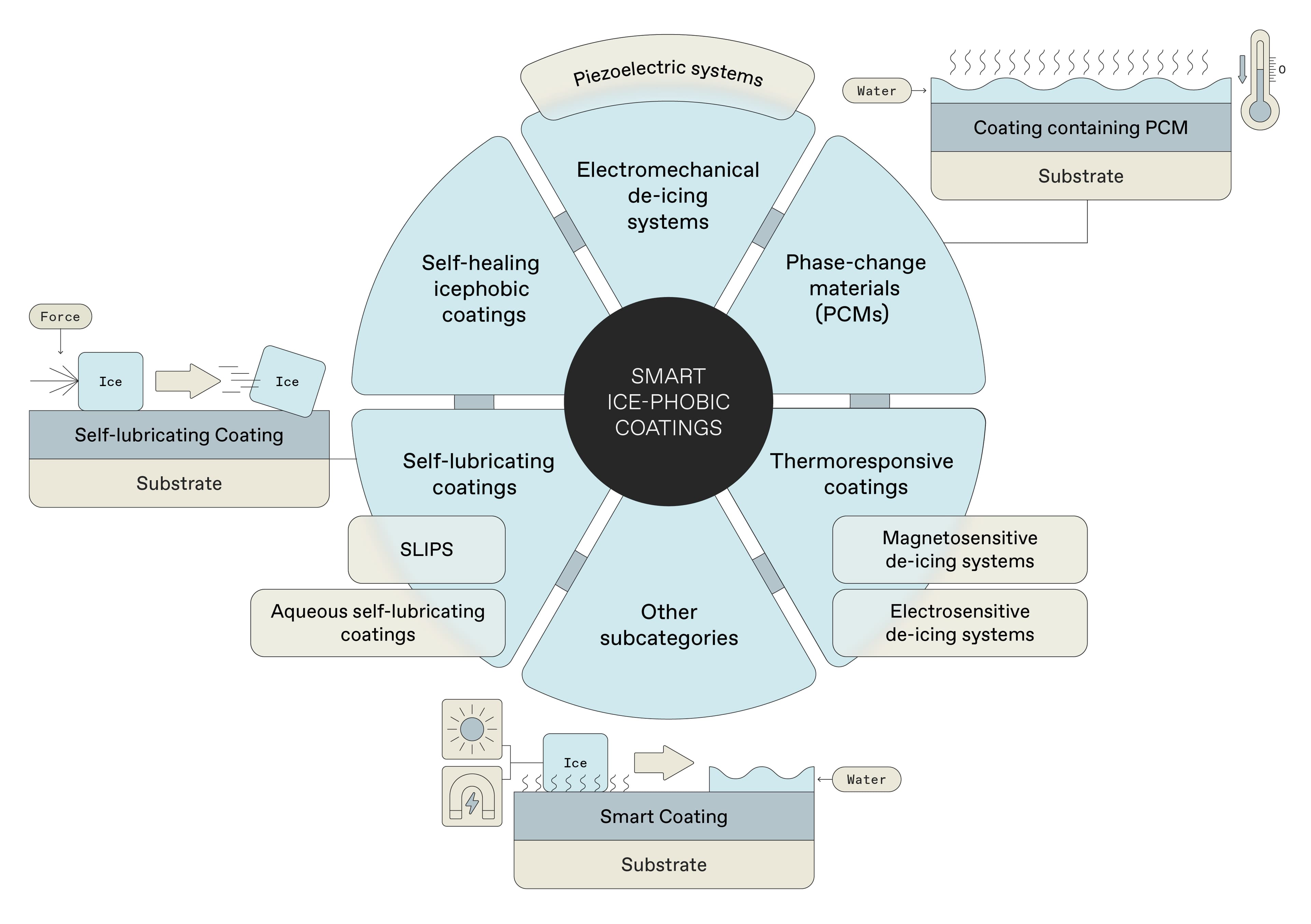
The illustration above shows a group of passive and activatable solutions designed to control ice-surface interaction through complementary mechanisms. These include self-lubricating coatings (SLIPS and aqueous formulations), self-healing coatings, phase change materials (PCMs) and thermo-reactive coatings, which can be coupled with electromechanical, piezoelectrical, electro-sensitive or magneto-sensitive de-icing systems.
By acting at the ice-substrate interface, these approaches reduce ice adhesion, delay ice nucleation and facilitate ice detachment under mechanical stress or external stimuli, while limiting dependence on energy-intensive, active de-icing systems.
However, the transition from laboratory to field remains the decisive test. This is where industrial applicability becomes a key criterion.
Materials in real-world applications
Work has been applied to operational aeronautical systems, notably as part of a major IDEeS project with National Defence called “Breaking the ice — ground solutions for removing frozen contaminants from aircraft”, which aimed to protect the rotors of Bell 412 helicopters used in critical missions.
The objective was not to replace certified active systems, but to supplement them with coatings capable of reducing ice adhesion and delaying its formation. This approach increases icing tolerance, reduces the demand in energy and improves operational resilience in situations where time is of the essence and human lives are at stake.
This feedback from real-world conditions reinforces the relevance of hybrid approaches, in which materials directly contribute to reducing the amount of energy consumed.
Towards a hybrid and energy-efficient approach
All of this work points to one clear conclusion: ice management requires a hybrid approach, combining active solutions and passive materials. This approach reduces energy consumption, limits the use of chemicals, increases the resilience of systems in the face of more severe weather conditions, and contributes to the decarbonisation of air operations.
A discreet but structuring leverage for aeronautics
In the aviation industry, decarbonisation does not depend solely on alternative fuels or the electrification of propulsion systems. It also involves reducing the energetic and chemical requirements associated with operations, especially in cold environments.
In this context, ice-phobic materials and coatings play a strategic role. By acting at the ice-surface interface directly, they delay ice formation, reduce its adhesion and facilitate its detachment under moderate mechanical stress. This action, happening upstream of the icing phenomenon, reduces the severity of the conditions encountered and, consequently, the stress on active de-icing systems.
A complex phenomenon
Icing is a complex phenomenon that cannot be resolved with a single solution. By combining active methods, anti-icing fluids and innovative ice-phobic materials, it then becomes possible to design more robust, energy-efficient strategies that are better suited to current climatic realities.
The objective of this work is clear: make materials a central lever of safety, performance and sustainability for the Nordic aerospace industry.
References and websites
https://aviation-safety.net/wikibase/308045
S Benaissa, D Harvey, G Momen, Thermographic analysis of ethylene glycol–based aircraft anti-icing fluid: Investigation of fluid failure mechanisms during simulated snow endurance tests, Cold Regions Science and Technology 234, 104472, 2025.
C Charpentier, JD Brassard, M Marchetti, G Momen, Airport Traffic Simulator for Anti-icing Runway Winter Products: Chemical Performance by Mechanical Activation, Results in engineering, Vol. 28, 107170, 2025.
E Villeneuve, C Charpentier, JD Brassard, G Momen, A Lacroix, Aircraft anti-icing fluids endurance under natural and artificial snow: a comparative study International Review of Aerospace Engineering (IREASE) 15 (1), 1-11, 2022.
M Shamshiri, R Jafari, G Momen, Icephobic properties of aqueous self-lubricating coatings containing PEG-PDMS copolymers, Progress in Organic Coatings 161, 106466, 2021.
M Shamshiri, G Momen, R Jafari, Icephobic coatings beyond boundaries: Layered integration of phase change materials beneath a PEG-PDMS copolymer–containing coating to enhance anti-icing performance, Progress in Organic Coatings 189, 108324, 2024.
M Bakhtiari, G Momen, R Jafari, Photothermal polyurethane coatings with functionalized nanoparticles and quasi-liquid layer for enhanced anti-icing and solar-assisted de-icing,
Solar Energy 300, 113859, 2025.
S Roshan, G Momen, R Jafari, I Fofana, S Brettschneider, Advanced dual-responsive silicone-based nanocomposites: Enhancing the de-icing efficacy of power transmission lines by harnessing magnetic and solar energy, Materials Today Communications, 113714, 2025.
M Shamshiri, R Jafari, G Momen, Potential use of smart coatings for icephobic applications: A review, Surface and Coatings Technology, Vol. 69, 424, 127656, 2021.
E Bakhshandeh, S Sobhani, R Jafari, G Momen, From theory to application: Innovative ice-phobic polyurethane coatings by studying material parameters, mechanical insights, and additives,
Surfaces and Interfaces Vol. 51, 104545, 2024.