It was a rainy, foggy Friday evening. The date was late November 1963. Even though it was past 6 p.m., Pierre Jeanniot had not yet left his office at Trans-Canada Airlines in Dorval. The phone rang. On the other end of the line was the Technical Control Center. “We've just had an accident in Ste-Thérèse. Be on standby.”
Flight TCA 831 has just crashed north of Montreal.
He doesn't know it yet but by going there, despite the horror of the situation, Pierre Jeanniot, a then young head of the TCA Maintenance Division, will make an observation that will give him a brilliant idea.
An idea that will revolutionize commercial aviation across the globe. And for years to come.
“It was grim. It was apocalyptic,” Pierre Jeanniot recounted in a 2013 interview. “A number of things were incinerated due to the intense fire.”
“I was very concerned. It was a brand new device, brand new. And we had several of them. If it was a problem specific to the device, it was crucial to find out.
But in the swamp in Sainte-Thérèse, near 89th Avenue, amid the smell of kerosene and the twisted debris, it was difficult to find anything that could provide a clear indication of the causes of the plane crash—the worst in Canadian history at the time.
There was indeed a device aboard the DC-8 nicknamed the “flight recorder”. But Pierre Jeanniot quickly realized that it would be of no use to him.
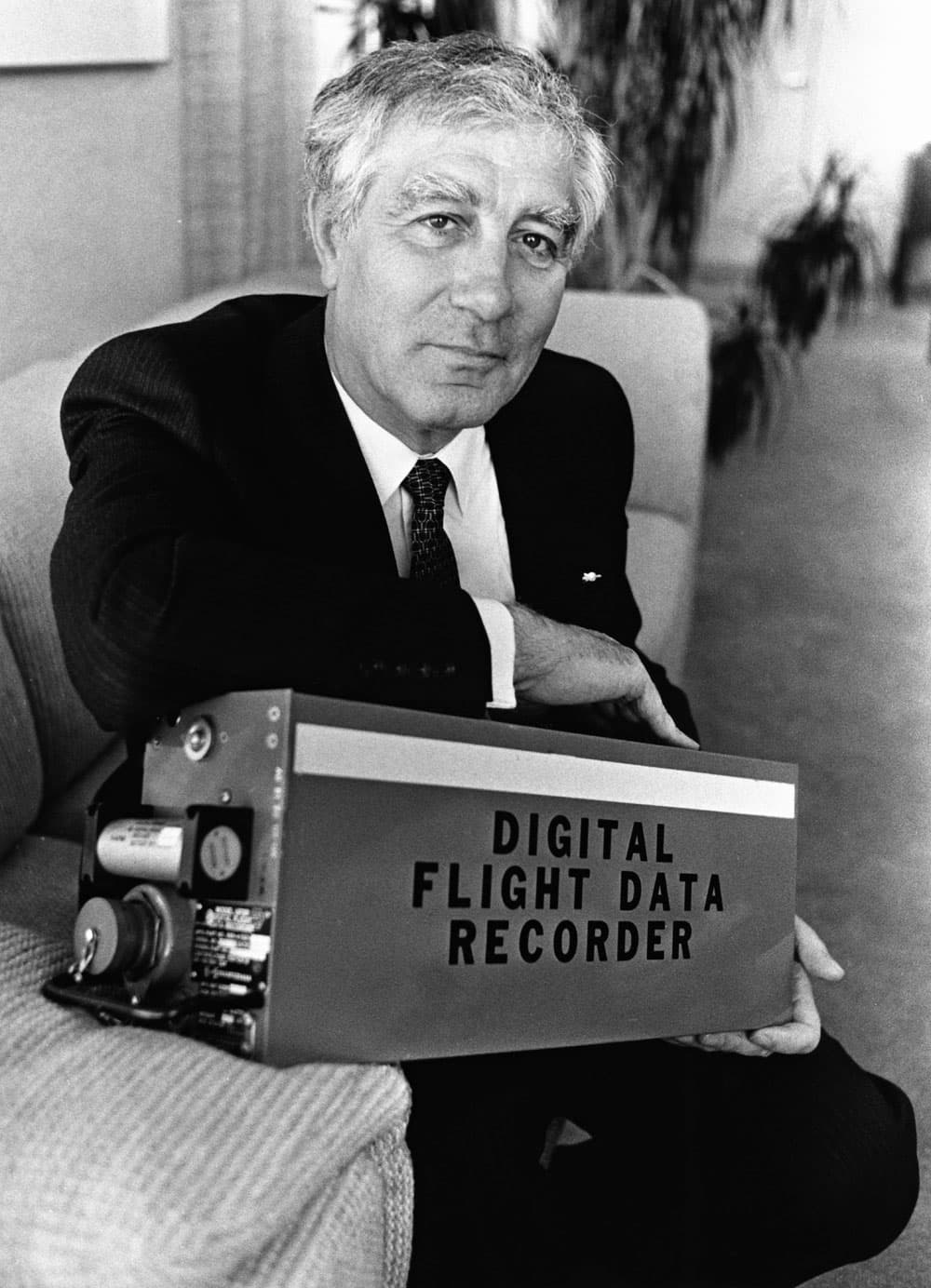
“It really upset me, I must say. That flight recorder had been pulverized! So, it was completely useless. It pained me greatly. And then one day, I had an idea: ‘What if we took the recorder as it is and buried it in a container that could withstand impact, and fire, then—maybe—we could read it afterwards!’”
“So, the solution I came up with was to take that recorder, change the settings to make them even more attuned with the flight plan, and put it all in a cylinder that could withstand fire and impact.”
Thus was born the black box—which was never black, but orange.
“People forget, you know.”
Today, in 2025, has Pierre Jeanniot received all the recognition he deserves? “No,” his son Michel Jeanniot replies without hesitation in an interview with Propelia. “People forget, you know.”
“My father was a man behind the scenes. He wasn't a politician. He was a statesman without a mandate.”
As proof, Michel Jeanniot cites an article from the French magazine L'Express, published in the early 1990s, about his father. “It was a publication about the 10 most influential men on the planet that no one knew. And my father was on that list!” he recalls with a hint of amusement.
However, Pierre Jeanniot made his mark in the aviation industry, and in many ways.
A revolution: non-smoking flights
He invented the concept of “business class.” Non-smoking flights were his idea too.
“It was a very significant risk,” recalls Michel Jeanniot.
“My father was a smoker at the time. He tried to quit but couldn’t do it. He was convinced that this was the future of the airline industry.”
The year is 1987. Pierre Jeanniot, having climbed the corporate ladder, has been at the helm of Air Canada as president and CEO for three years. And his latest idea is far from going unnoticed.
“It shook the very foundations of the industry, recalls his son. Several people were getting worked up at the board meeting, saying, ‘We can't do that! Our clientele is a business clientele!’”
Air Canada's marketing specialists called it a rash decision with devastating consequences. The powerful tobacco industry even launched a boycott campaign against the company.
And rather than going into a tailspin, Air Canada's passenger numbers actually increased... by 5%!
“I don't mean to say he was stubborn. But once he was convinced that this was the direction to take, nothing could stop him. Perhaps that's the definition of a visionary.”
When he talks about his father, Michel Jeanniot can barely conceal his pride. But he remains realistic. His father’s greatest failure, according to him, is that “while he was on the list of the 10 most influential people... he was also on the list of the 10 poorest!” he says, in between laughs.
“When he left Air Canada, it took two or three years to replace him. No one wanted the job for the same salary as my father. They finally found an executive from Continental Airlines who lived in Atlanta. This guy said: ‘I have two conditions: you triple the salary and you establish a direct connection to Atlanta every day of the week.’”
“The guy would arrive on Sunday evening and leave on Wednesday morning for Atlanta,” says Michel Jeanniot.