My name is David Rancourt, I’m a professor and commercial pilot with over 1,500 flight hours, mainly in general aviation. For 20 years, I contributed to the Air Cadet flight program as an instructor and pilot. Since 2017, I have been teaching and conducting research in mechanical and aeronautical engineering at the University of Sherbrooke, and my projects focus on improving flight performance and reducing environmental impact.
I am also involved in Quebec's aerospace industry, particularly within Zone Aéro, the aerospace innovation zone. In short, I wear many hats—or, as we say, I “bridge the gap” between theory and practice.
It was in this context that I had the unique opportunity to test the B23 Energic at the end of August 2025, at the MET — Montreal Metropolitan Airport.

Batteries in the wings
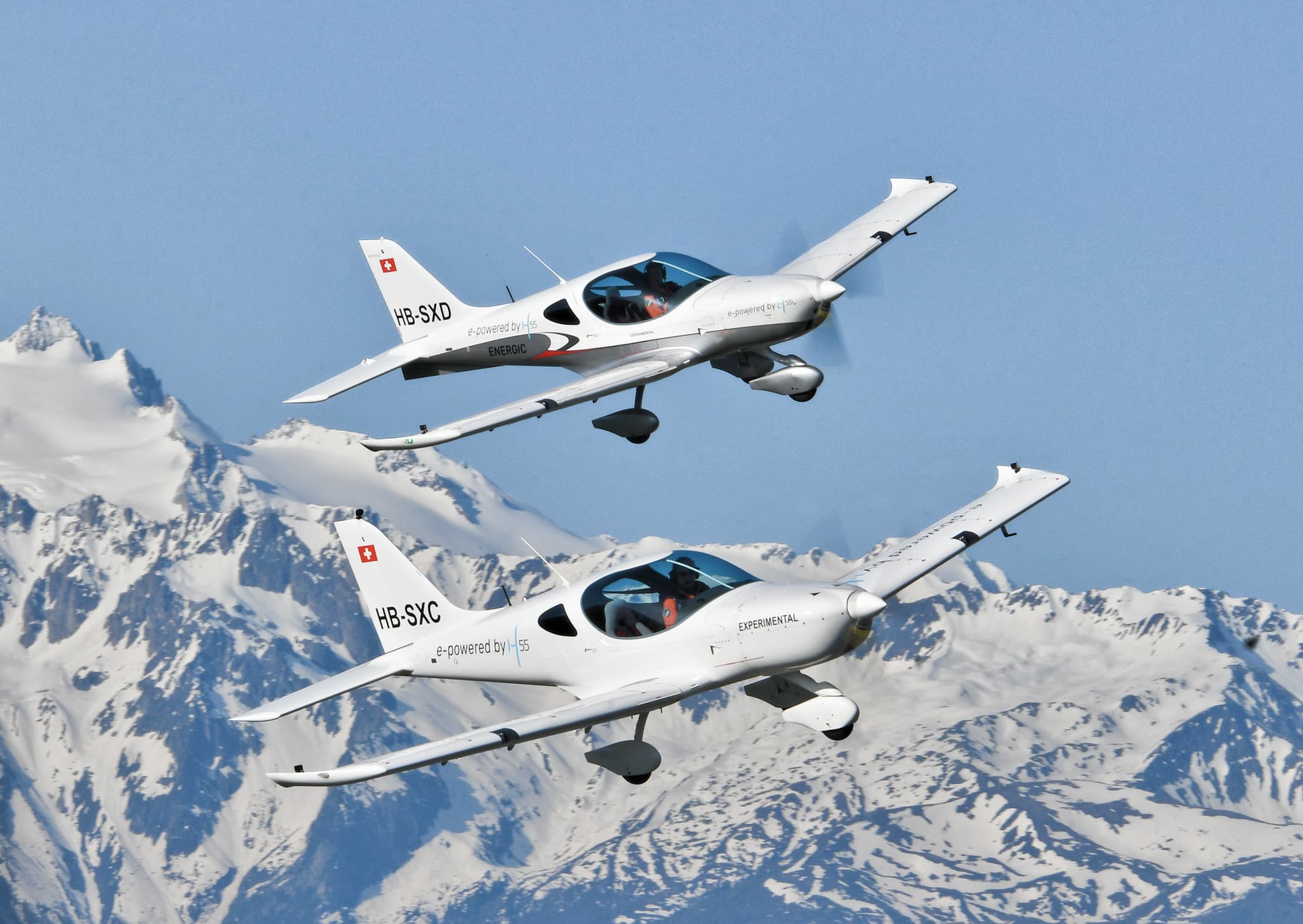
The B23 Energic is a re-engined version of the Bristell B23, an aircraft certified according to standards CS23 (Europe) and FAR23 (United States). The standard version of the B23 is equipped with a modern Rotax engine that runs on unleaded fuel. The electric version is powered by an electric motor fed by batteries located in the wings and in certain areas of the fuselage.
Its current purpose is limited to short flights of about one hour at reduced speed, with a regulatory reserve of 30 minutes for visual flights. Its limited range means it is mainly intended for flight schools, to support part of the training of future pilots. The major limitation remains the energy capacity of the batteries, but improvements are expected in the future.
Demonstration flight
On August 28, 2025, I head to H55 for the opening of the new H55 Canada offices, located directly on the airport grounds. After formalities and signing the waivers (it’s still a prototype!), we prepare for the flight. The aircraft has 46 kWh available out of a total capacity of 49 kWh. Therefore, the aircraft is essentially full. The battery has about 20% less capacity than a Tesla Model 3 battery, but in an aircraft weighing half as much. The battery therefore accounts for a significant portion of the aircraft's total weight, leaving enough weight for two relatively light pilots.
It is worth noting here that people often make the mistake of comparing electric cars to electric planes. This leads them to believe that, if Tesla has succeeded in making cars with a range similar to that of gasoline-powered cars, we can achieve the same with electric aircraft if we put enough effort into it. Unfortunately, the increased weight of the aircraft leads to an increase in energy consumption, and therefore of battery use. At takeoff, batteries account for about 30% of the aircraft's weight.
The weather forecast indicates a wind speed of 15 knots, with gusts of up to 22 knots, blowing at a 45-degree angle on track 24R. This is a relatively high wind speed for a training aircraft, but it is still within acceptable limits. In fact, the flight schools based at the airport were conducting flights on the same day. After waiting for about an hour and enjoying great conversations with pilot Laurent Wülser, legend André Borschberg (pilot of the Solar Impulse, the aircraft that flew around the world in 2015 and 2016) and Gregory Blatt (H55), we are ready for the flight.

Discovering the cockpit
Once seated in the cockpit, I discover a simple and functional dashboard; my attention is drawn to the energy and power indicators. The rest of the avionics are simple and minimalist. Let's remember that this is a prototype and that the commercial version will comprise a full avionic suite like the gasoline-powered B23. The electrical system display, although minimalist, provide essential information: instantaneous power, component temperatures, remaining battery capacity. However, it takes some time to adapt to reading and converting this data into flight time, compared to traditional benchmarks (intake pressure, RPM).
Although we are dealing with an electric motor, there is a “start-up” phase. The motor runs at 200 rpm, which is well below the idle speed of a conventional gasoline engine, and maintains this speed. I assume that the objectives of having an “idle” mode are to: 1) avoid the downtime typically observed when accelerating an engine from a standstill; and 2) emulate the operating characteristics of a gasoline engine. The power required is about 1 kW at “idle”, compared to more than 5 liters of gasoline per hour for a Cessna 172 under similar conditions. It should be noted that the idle speed of a Cessna 172 engine is around 700 rpm, and that we maintain the rotation speed at 1,000 rpm on the ground to reduce vibrations and promote engine cooling.
First observation: the noise level is very low, comparable to that of a car on the highway, which allows us to talk without headphones. The—almost—total absence of vibrations is similar to that of a turboprop engine.
The ground handling phase (or “taxi-in” phase) is slightly different. The B23 is controlled exclusively by ground brakes and is therefore not linked to electric propulsion in any way, a shared feature with gasoline-powered aircraft such as the Cirrus family. The aircraft's ground handling and visibility are impeccable, reminding me of an aircraft like the Van RV6 or its low-wing equivalent. As mentioned earlier, the engine’s idle speed is much lower than that of a gasoline-powered aircraft—more than three times slower. As a result, thrust is nine times lower at idle. This phenomenon becomes apparent when taxiing. In a conventional aircraft, the engine speed is increased to accelerate the aircraft. Then, the power is reduced to—almost—minimum during taxiing. In the case of the B23, this characteristic causes the aircraft to move forward a few meters... before stopping again.
Ready for takeoff!
After a short taxi, we perform the usual engine checks before takeoff. Unlike a gasoline-powered aircraft, where engine checks include items such as ignition system (or mag check) and the carburetor heater, the B23 Energic checks concern the electrical system, more specifically the system that allows the engine control to be bypassed with a switch, and the temperatures of the electrical components. This system provides redundancy in the event of a power control failure. Once the engine check is complete, we line up on track 24R.
Once we have clearance, we apply 95 kW of power. Rotation and takeoff at 70 knots. Steep climb at over 800 feet/minute. The performance is reminiscent of a Cessna 172, confirming that this is indeed an airplane and not an ultralight. The noise in the cabin increases, but remains lower than that of a combustion engine, and comes mainly from the propeller rather than the electric motor. During this phase of flight, it would not be realistic to remove our headphones to talk in the cockpit.
Cruising at 1,000 feet above ground level, we reduce the power to 40 kW, stabilizing speed at 90 knots. The noise level drops significantly, reminiscent of a glider being towed or flying at high speed. Vibrations are very low, much less than those experienced in a Cessna 172, for example. The B23 is very maneuverable, pleasant to fly, and offers excellent visibility. Keeping in mind the limited capacity of the battery, I keep a close eye on the remaining energy as well as the temperature of the various electrical components. After a few minutes, I get used to the display and realize that there is plenty of energy to complete the planned flight. It would be possible to slightly increase the flight time by reducing the speed below 90 knots. A flight speed of over 120 knots would be possible too, at higher power. In the latter case, flight time would be reduced by more than 40%—which is to be avoided for long-distance flights.
We perform a few turns to appreciate the aircraft's maneuverability. It's a pleasure to steer; it reminds me of a Van RV6 flying at low speed. The controls are light. The aircraft's response is very smooth. It's truly a pleasure to pilot, and you quickly forget that you're flying an electric aircraft, except for the very low cabin noise!
Returning on ground
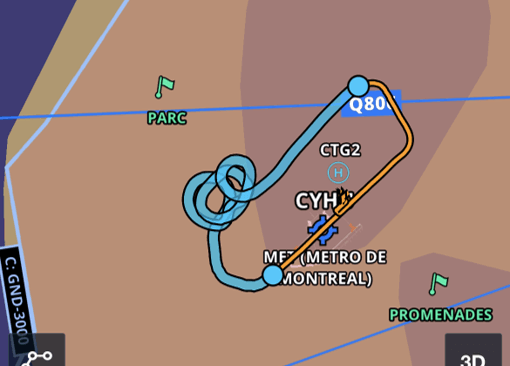
After a few turns, we begin our descent and land on track 24R, in the same weather conditions as the takeoff. The plane responds very well to crosswinds... if not better than a Cessna 172. The landing is smooth. We taxi back to the HUB FBO apron, next to H55 at CYHU, after receiving clearance from the control tower. After a few exchanges with the controllers—who are curious about the aircraft's performance—we “shut down” the engine and the aircraft's electrical system. There is 38 kWh left in the battery: a consumption of only 17% for a flight of about 10 minutes. The plan was to make a subsequent flight without recharging the batteries.
In conclusion, I was pleasantly surprised by the B23 Energic’s performance, maneuverability, and the comfort of an electric flight. Noise is reduced, although still present at high power. This prototype already meets the needs of flight schools for short flights, but it remains limited to private pilots travelling between airports, due to its lack of range and suitable infrastructure. However, we should not assume that these kinds of aircraft will replace all gasoline-powered training aircraft, nor private aircraft, which require much greater range than today's electric aircraft.
Despite these constraints, the B23 Energic represents a promising first step toward a more environmentally friendly aviation, particularly in pilot training.